Open-Source Fire Science

Case STudy 2018 Camp Fire

2018 Camp Fire

Ignition: 11/8/18 near Paradise, CA

On November 8, a strong Diablo wind event created strong winds over the Sierra Nevada Mountains, with locally strong winds near the Jarbo Gap and Feather River Canyon.

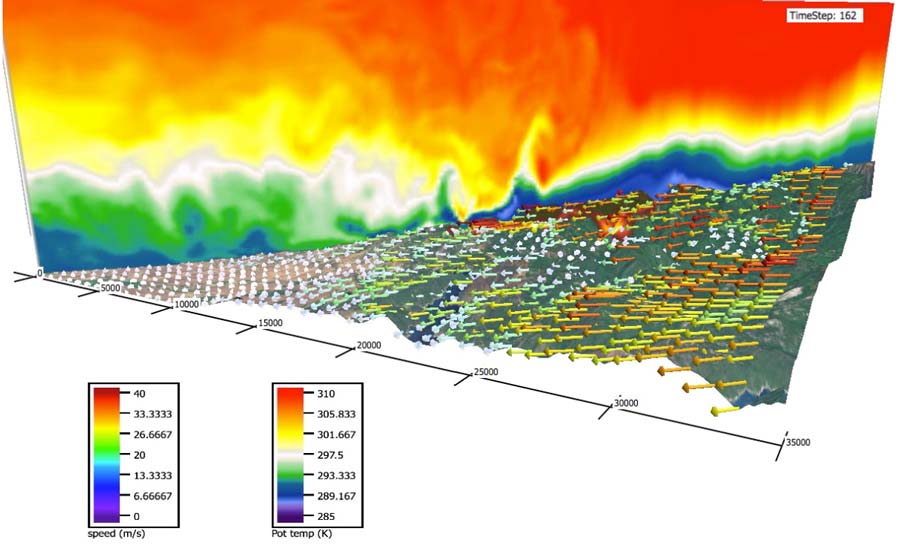
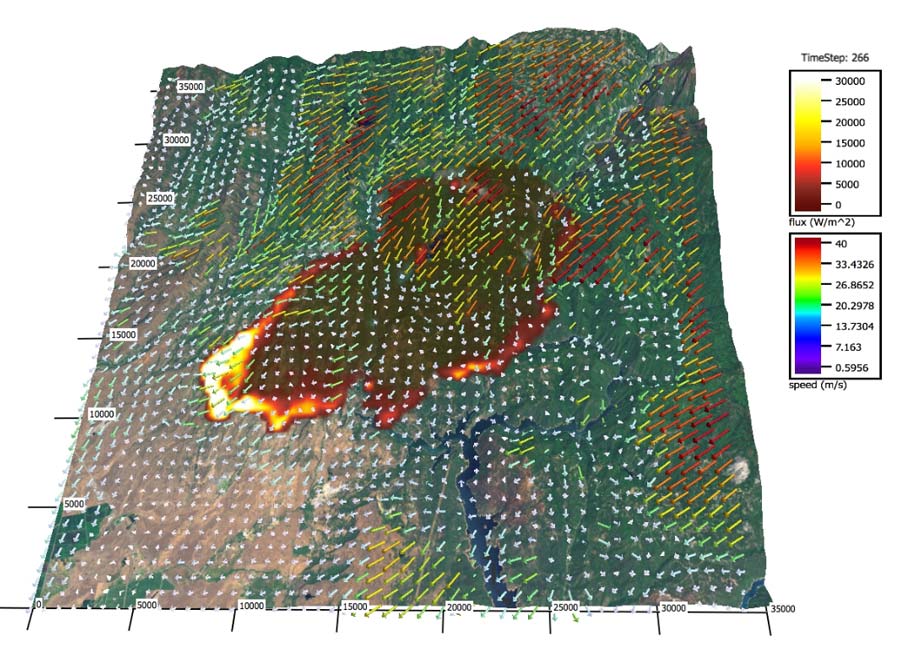
Research simulations using CAWFE showed that extreme winds, created by a shear instability along the top of a shallow, near-surface stable layer (a phenomena that resembles backwards-breaking waves) brought strong winds crashing to the surface, driving the fire rapidly down the slope. (Fig. C1)

2018 Camp Fire
Figure C1. CAWFE simulation of the Camp Fire. The fire’s heat flux is show in the upper color bar (in W m-2). Wind speed arrows (in m s-1) point downstream and are colored according to the color bar at right. Vectors are shown every 3 grid points.
2018 Camp Fire
Figure C2. CAWFE simulation of the Camp Fire. The fire’s heat flux is show in the upper color bar (in W m-2). Wind speed arrows (in m s-1) point downstream and are colored according to the color bar at right. Vectors are shown every 3 grid points.

CAWFE simulation

This vertical cross section down the center of the fire shows the shear instability as rapidly spreading heavy air (lower potential temperatures) is lifted into slower moving air above it, creating the impression of retroflecting (backwards breaking) waves (Fig. C2). As strong winds are crash down to the surface, they spread outward in scallops of strong winds that drove the fire rapidly down slope (Fig.C1, at left.)

CAWFE simulation